Research

Themes

My group’s research focuses on paleoclimatology – the study of past climates – along the following themes. For more details, see our publications.

Climate Reconstruction
Climate Reconstruction

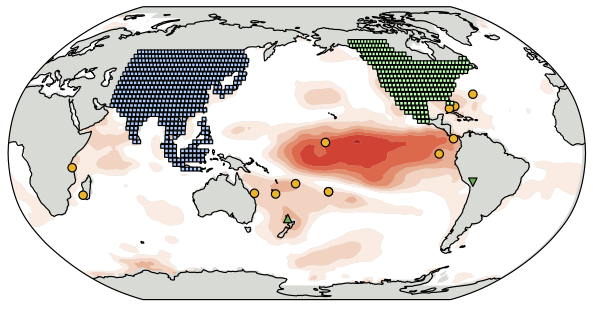
Our group has been involved with reconstructions of El Niño-Southern Oscillation (ENSO, [1,2]), global mean surface temperature [3,4], and multiple fields [5,6]. We have also been active in benchmarking reconstruction techniques [79].

Climate Modeling

Climate Modeling

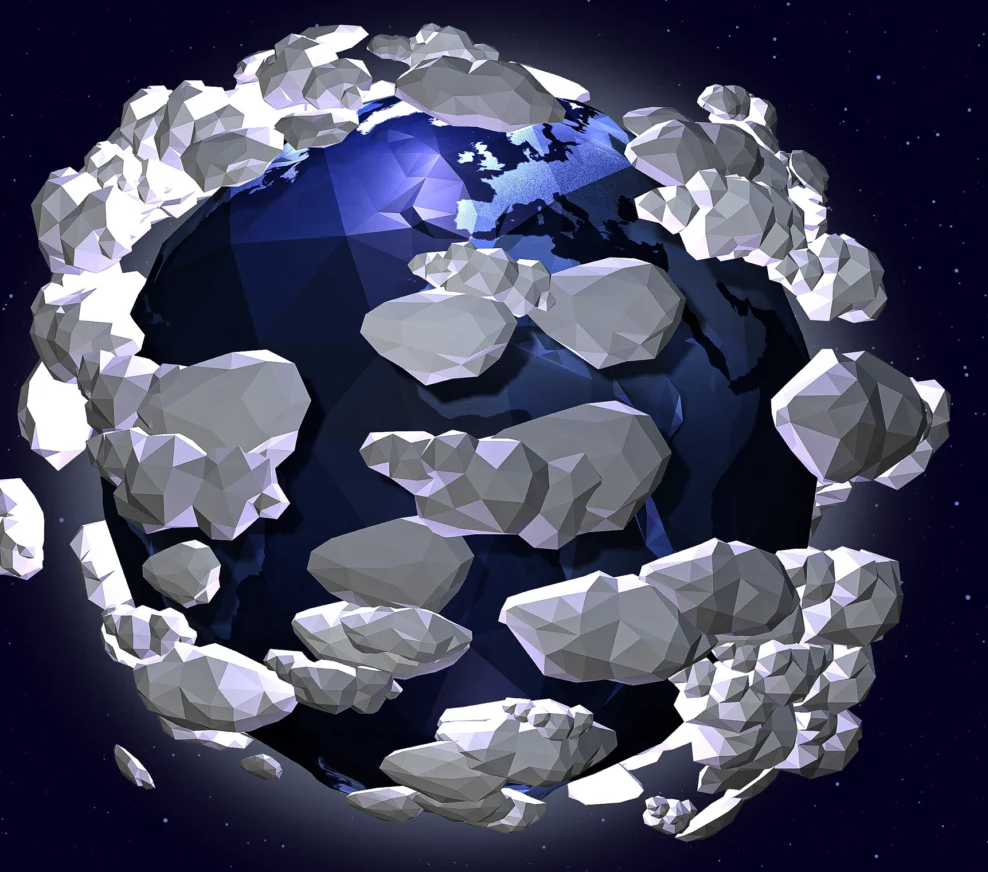
Our group has participated in the development [10] and evaluation of climate models, examining how models represent ENSO [11], simulate volcanic eruptions [12], fractionate water isotopes [13,14], and simulate the climate continuum [15]. Paleoclimatology is particularly suited for model evaulation, as past climates provide an out-of-sample test of model predictions. Picture credit: Quanta Magazine.

Data Science
Data Science

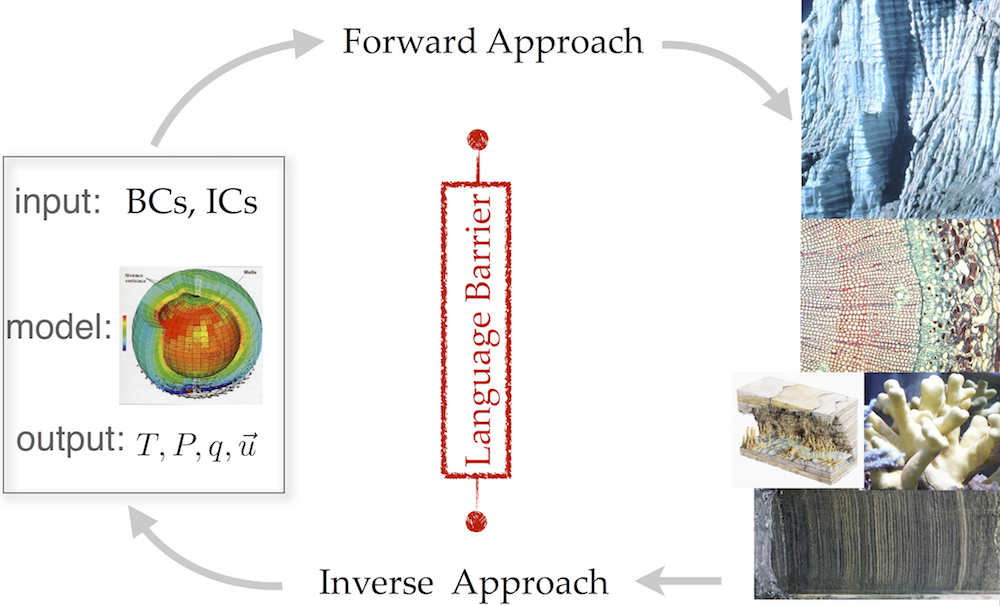
We develop methods for paleoclimate data assimilation [5,16], climate field imputation [17,18], uncertainty quantification [19,20], and time series analysis [21,22].

Proxy Interpretation

Proxy Interpretation

We have furthered understanding of how paleoclimate “proxies” encode climate signals through proxy system models [10,2325]. Alumni Jun Hu and Alex James have investigated speleothem records [14,26] on orbital [27] and shorter [28] timescales.

Open Science

Open Science

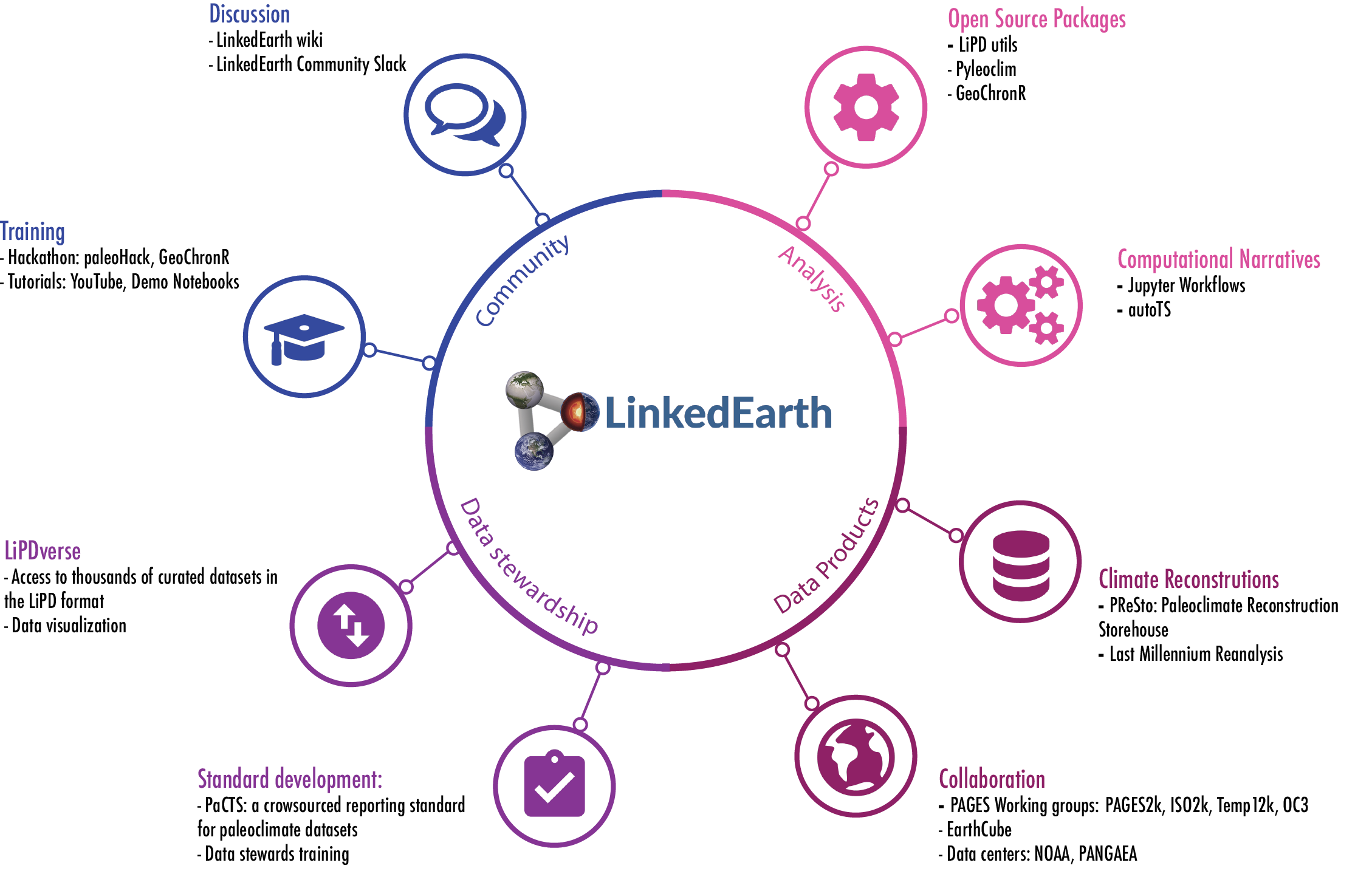
A throughline of our research is open science, exemplified by data compilations [29,30], data standards [3133], and open-source software [16,22,34,35]. More at the LinkeEarth website.

Current Projects

LMR4D: P4CLIMATE — Connecting Seasonal to Millennial Timescales through Strongly Coupled Data Assimilation

NSF P4CLIMATE AGS-2402475 | Co-PI (PI: G. Hakim, UW) | 2024–2026

LMR4D is the latest iteration of the Last Millennium Reanalysis implementing a 4D variational (4DVAR) data assimilation framework — the same approach used in operational numerical weather prediction — to produce seasonally resolved temperature reconstructions over the Common Era. LMR4D will leverage data from new sources, including documentary evidence, marine sediments, annually-resolved marine bivalve chronologies, as well as boreholes. The resulting seasonally resolved reconstruction will be applied to (A1) simulate tropical cyclone track and intensity statistics using deep-learning weather models (Pangu-Weather, FourCastNet, DLWP), extending TC records by centuries and enabling the first millennial-scale simulations of tropical cyclone statistics, and (A2) characterize sources of climate variability across the seasonal-to-centennial continuum, including volcanic forcing responses and constraints on equilibrium climate sensitivity. LMR4D products will be publicly accessible via PReSto and NOAA NCEI; the 4DVAR algorithm and proxy system models will be shared on GitHub, with reproducible workflows distributed via PaleoBooks. The project is training two graduate students and several undergraduates.

PaleoPAL: An AI Research Assistant for Paleoclimatology

NSF CAIG RISE 2425885 | Co-PI (Lead: D. Khider, ISI) | 2025–2027

PaleoPAL leverages a Retrieval-Augmented Generation (RAG) – Large Language Model (LLM) framework to create an AI assistant for paleoclimatology, enabling scientists to search for datasets, methods, and workflows appropriate to their research problem directly from a Jupyter Notebook. The project targets three critical research areas: placing recent El Niño variations in the context of the last 10,000 years, detecting climate tipping points and their potential precursors, and generating empirically-based, low-cost climate projections. By embedding AI directly into the practice of paleoclimatology through a familiar Jupyter interface, PaleoPAL aims to lower technical and conceptual barriers to sophisticated analyses across the paleoclimate community.

PaleoCube: Enabling Cloud-Based Paleoclimatology

NSF EarthCube ICER 2126510 | Co-PI (Lead: D. Khider, ISI) | 2021-2024

PaleoCube proposes to lower technical and social barriers that prevent full use of paleoclimate observations by bringing scientists to work in the Cloud. The project extends existing cyberinfrastructure (LinkedEarth, Pangeo, Jupyter) to bring cutting-edge capabilities to paleoclimate scientists through cloud-based workflows, hackathons, and community engagement.

PReSto: A Paleoclimate Reconstruction Storehouse

NSF Geoinformatics EAR 1948822 | Co-PI (Lead: N. McKay, NAU) | 2020-2026

Developing a continuously-updated platform for paleoclimate reconstructions with broad web access to accelerate scientific inference. PReSto will connect growing digital paleoclimate data to evolving methodologies and distribute results through responsive web interfaces.

Past Projects

FROGS: Facilitating Reproducible Open GeoScience

NSF GEO OSE Track 1 RISE-2324732 | Co-PI (Lead: D. Khider, ISI) | 2024-2026

Building open science capacity in the geosciences through the LeapFROGS training platform and a series of hands-on workshops (PyRATES, FAIRLeap, Open Geoscience Hackathon). Three workshops engaged 56 participants across more than a dozen geoscience subfields and career stages, producing 8 reproducible notebooks and 9 open-source software packages. Post-event surveys showed over 90% of participants gained confidence in applying FAIR and reproducible research methods.

A Big Data Approach to Fundamental Paleoclimate Questions

NSF P2C2 AGS 2002556 | Lead PI | 2020-2023

Applying Big Data approaches to address fundamental questions in climate dynamics: (1) the spatial extent of abrupt changes in hydroclimate, and (2) how knowledge of past temperature variations can help reduce uncertainty in twenty-first century climate projections. Links paleoclimate data to CMIP6 climate model projections.

The Global Climate Response to Volcanic Eruptions

NOAA Climate Program Office NA18OAR4310426 | Lead PI | 2018-2020

Investigating volcanic climate impacts using the Last Millennium Reanalysis framework.

Abrupt Change in Climate and Ecosystems

Belmont Forum via NSF ICER 1929554 | Co-PI (Lead: N. McKay, NAU) | 2019-2022

International collaboration investigating tipping points in climate and ecosystems through integrated analysis approaches. Part of the Belmont Forum’s focus on understanding where critical thresholds exist in Earth system components.

LinkedEarth: Crowdsourcing Data Curation & Standards

NSF EarthCube ICER 1541029 | Lead PI | 2015-2017

Community platform development for paleoclimate data standards and knowledge curation.

Last Millennium Climate Reanalysis Project

NOAA Climate Program Office NA14OAR4310175 | Co-PI (Lead: G. Hakim, UW) | 2014-2017

Developing data assimilation methods for paleoclimate reconstructions over the Common Era.

GeoChronR: Open-Source Tools for Time-Uncertain Data

NSF Geoinformatics EAR 1347213 | Co-PI (Lead: N. McKay, NAU) | 2014-2017

Analysis, visualization and integration tools for geochronological data with age uncertainties.

Efficient High Dimensional Bayesian Methods for Climate Field Reconstruction

NSF Mathematical Geophysics DMS 1025464 | Co-PI (Lead: B. Rajaratnam, Stanford) | 2010-2015

Statistical method development for spatially complete climate reconstructions.

Multiproxy Reconstructions as A Missing-Data Problem

NSF P2C2 GEO 1003818 | Lead PI | 2010-2015

New techniques for multiproxy climate reconstructions and their application to regional climates of the past millennium.

Maximizing the Potential of Tropical Climate Proxies

NOAA Climate Program Office NA10OAR4310115 | Lead PI | 2010-2014

Integrated climate-proxy forward modeling to maximize the climate information extractable from tropical paleoclimate proxies.

References

1.
J. Emile-Geay, K. M. Cobb, M. E Mann, Andrew T. Wittenberg. Estimating Central Equatorial Pacific SST variability over the Past Millennium. Part 2: Reconstructions and Implications. J Clim. 2013;26:2329–52. doi:10.1175/JCLI-D-11-00511.1
2.
Feng Zhu, Julien Emile-Geay, Kevin J. Anchukaitis, Gregory J. Hakim, Andrew T. Wittenberg, Mariano S. Morales, Matthew Toohey, Jonathan King. A re-appraisal of the ENSO response to volcanism with paleoclimate data assimilation. Nature Communications. 2022;13(1):747. doi:10.1038/s41467-022-28210-1
3.
Luis A. Barboza, Julien Emile-Geay, Bo Li, Wan He. Efficient Reconstructions of Common Era Climate via Integrated Nested Laplace Approximations. Journal of Agricultural, Biological and Environmental Statistics. 2019. doi:10.1007/s13253-019-00372-4
4.
Raphael Neukom, Luis A. Barboza, Michael P. Erb, Feng Shi, Julien Emile-Geay, Michael N. Evans, Jörg Franke, Darrell S. Kaufman, Lucie Lücke, Kira Rehfeld, Andrew Schurer, Feng Zhu, Stefan Brönnimann, Gregory J. Hakim, Benjamin J. Henley, Fredrik Charpentier Ljungqvist, Nicholas McKay, Veronika Valler, Lucien von Gunten. Consistent multidecadal variability in global temperature reconstructions and simulations over the common era. Nature Geoscience. 2019;12(8):643–9. doi:10.1038/s41561-019-0400-0
5.
Gregory J. Hakim, Julien Emile-Geay, Eric J. Steig, David Noone, David M. Anderson, Robert Tardif, Nathan Steiger, Walter A. Perkins. The last millennium climate reanalysis project: Framework and first results. Journal of Geophysical Research: Atmospheres. 2016;121:6745–64. doi:10.1002/2016JD024751
6.
R. Tardif, G. J. Hakim, W. A. Perkins, K. A. Horlick, M. P. Erb, J. Emile-Geay, D. M. Anderson, E. J. Steig, D. Noone. Last millennium reanalysis with an expanded proxy database and seasonal proxy modeling. Climate of the Past. 2019;15(4):1251–73. doi:10.5194/cp-15-1251-2019
7.
J. Wang, J. Emile-Geay, D. Guillot, J. E. Smerdon, B. Rajaratnam. Evaluating climate field reconstruction techniques using improved emulations of real-world conditions. Climate of the Past. 2014;10(1):1–19. doi:10.5194/cp-10-1-2014
8.
Jianghao Wang, Julien Emile-Geay, Dominique Guillot, Nicholas P. McKay, Bala Rajaratnam. Fragility of reconstructed temperature patterns over the common era: Implications for model evaluation. Geophysical Research Letters. 2015;42:7162–70. doi:10.1002/2015GL065265
9.
Feng Zhu, Julien Emile-Geay, Kevin J. Anchukaitis, Nicholas P. McKay, Samantha Stevenson, Zilu Meng. A pseudoproxy emulation of the PAGES 2k database using a hierarchy of proxy system models. Scientific Data. 2023;10(1):624. doi:10.1038/s41597-023-02489-1
10.
S. Dee, D. Noone, N. Buenning, J. Emile-Geay, Y. Zhou. SPEEDY-IER: A fast atmospheric GCM with water isotope physics. Journal of Geophysical Research: Atmospheres. 2015;120(1):2014JD022194. doi:10.1002/2014JD022194
11.
J. Emile-Geay, K. M. Cobb, M. Carre, P. Braconnot, J. Leloup, Y. Zhou, S. P. Harrison, T. Correge, H. V. McGregor, M. Collins, R. Driscoll, M. Elliot, B. Schneider, A. Tudhope. Links between tropical pacific seasonal, interannual and orbital variability during the holocene. Nature Geosci. 2016 Feb;9(2):168–73. doi:10.1038/ngeo2608
12.
Feng Zhu, Julien Emile-Geay, Gregory J. Hakim, Jonathan King, Kevin J. Anchukaitis. Resolving the differences in the simulated and reconstructed temperature response to volcanism. Geophysical Research Letters. 2020;47(8):e2019GL086908. doi:10.1029/2019GL086908
13.
Jun Hu, Julien Emile-Geay, Jesse Nusbaumer, David Noone. Impact of convective activity on precipitation  in isotope-enabled general circulation models. Journal of Geophysical Research: Atmospheres. 2018;123(23):13, 595–13, 610. doi:10.1029/2018JD029187
14.
Jun Hu, Julien Emile-Geay, Clay Tabor, Jesse Nusbaumer, Judson Partin. Deciphering oxygen isotope records from chinese speleothems with an isotope-enabled climate model. Paleoceanography and Paleoclimatology. 2019;34(12):2098–112. doi:10.1029/2019PA003741
15.
Feng Zhu, Julien Emile-Geay, Nicholas P. McKay, Gregory J. Hakim, Deborah Khider, Toby R. Ault, Eric J. Steig, Sylvia Dee, James W. Kirchner. Climate models can correctly simulate the continuum of global-average temperature variability. Proceedings of the National Academy of Sciences. 2019 Apr;116(18):8728. doi:10.1073/pnas.1809959116
16.
F. Zhu, J. Emile-Geay, G. J. Hakim, D. Guillot, D. Khider, R. Tardif, W. A. Perkins. cfr (v2024.1.26): A python package for climate field reconstruction. Geoscientific Model Development. 2024;17(8):3409–31. doi:10.5194/gmd-17-3409-2024
17.
Dominique Guillot, Bala Rajaratnam, Julien Emile-Geay. Statistical paleoclimate reconstructions via Markov random fields. Ann Applied Statist. 2015;324–52. doi:10.1214/14-AOAS794
18.
Adam Vaccaro, Julien Emile-Geay, Dominque Guillot, Resherle Verna, Colin Morice, John Kennedy, Bala Rajaratnam. Climate field completion via markov random fields: Application to the HadCRUT4.6 temperature dataset. Journal of Climate. 2021;34(10):4169–88. doi:10.1175/JCLI-D-19-0814.1
19.
J. Emile-Geay, M. Tingley. Inferring climate variability from nonlinear proxies: Application to palaeo-ENSO studies. Climate of the Past. 2016;12(1):31–50. doi:10.5194/cp-12-31-2016
20.
Julien Emile-Geay, Gregory J. Hakim, Frederi Viens, Feng Zhu, Daniel E. Amrhein. Temporal comparisons involving paleoclimate data assimilation: Challenges & remedies. Journal of Climate. 2025. doi:10.1175/JCLI-D-24-0101.1
21.
Alexander James, Julien Emile-Geay, Nishant Malik, Deborah Khider. Detecting Paleoclimate Transitions With Laplacian Eigenmaps of Recurrence Matrices (LERM). Paleoceanography and Paleoclimatology. 2024 Jan;39(1):e2023PA004700. doi:10.1029/2023PA004700
22.
Deborah Khider, Julien Emile-Geay, Feng Zhu, Alexander James, Jordan Landers, Varun Ratnakar, Yolanda Gil. Pyleoclim: Paleoclimate timeseries analysis and visualization with python. Paleoceanography and Paleoclimatology. 2022;37(10):e2022PA004509. doi:10.1029/2022PA004509
23.
D. M. Thompson, T. R. Ault, M. N. Evans, J. E. Cole, J. Emile-Geay. Comparison of observed and simulated tropical climate trends using a forward model of coral. Geophys Res Lett. 2011;38:L14706. doi:10.1029/2011GL048224
24.
Sylvia G. Dee, Nathan J. Steiger, Julien Emile-Geay, Gregory J. Hakim. On the utility of proxy system models for estimating climate states over the common era. Journal of Advances in Modeling Earth Systems. 2016;8. doi:10.1002/2016MS000677
25.
S. G. Dee, L. A. Parsons, G. R. Loope, J. T. Overpeck, T. R. Ault, J. Emile-Geay. Improved spectral comparisons of paleoclimate models and observations via proxy system modeling: Implications for multi-decadal variability. Earth and Planetary Science Letters. 2017;476(Supplement C):34–46. doi:10.1016/j.epsl.2017.07.036
26.
Jun Hu, Julien Emile-Geay, Judson Partin. Correlation-based interpretations of paleoclimate data – where statistics meet past climates. Earth and Planetary Science Letters. 2017 Feb;459:362–71. doi:10.1016/j.epsl.2016.11.048
27.
Alexander James, Julien Emile-Geay, Judson W. Partin, Deborah Khider. Global speleothem analysis reveals state-dependent hydrological response to orbital forcing. Paleoceanography and Paleoclimatology. 2025;40(8):e2024PA005098. doi:10.1029/2024PA005098
28.
Alexander James, Jun Hu, Julien Emile-Geay, Judson W. Partin, Nick Scroxton, Nishant Malik, Yuan Gao. Regime Shifts in Holocene Paleohydrology as Recorded by Asian Speleothems. Paleoceanography and Paleoclimatology. 2025;40(1):e2024PA004974. doi:10.1029/2024PA004974
29.
Emile-Geay, J. and McKay, N. and Kaufman, D. and von Gunten, L. and Wang, J. and Anchukaitis, K. and Abram, N. and Addison, J. and Curran, M. and Evans, M. and Henley, B. and Hao, Z. and Martrat, B. and McGregor, H. and Neukom , R. and Pederson, G. and Stenni, B. and Thirumalai, K. and Werner, J. and Xu, C. and Divine, D. and Dixon, B. and Gergis, J. and Mundo, I. and Nakatsuka, T. and Phipps, S. and Routson, C. and Steig, E. and Tierney, J. and Tyler, J. and Allen, K. and Bertler, N. and Björklund and Chase, B. and Chen, M. and Cook, E. and de Jong, R. and DeLong, K. and Dixon, D. and Ekaykin, A. and Ersek V. and Filipsson, H. and Francus, P. and Freund, M. and Frezzotti, M. and Gaire, N. and Gajewski, K. and Ge, Q. and Goosse, H. and Gornostaeva, A. and Grosjean, M. and Horiuchi, K. and Hormes, A. and Husum, K. and Isaksson , E. and Kandasamy, S. and Kawamura, K. and Kilbourne, K. and Koc, N. and Leduc, G. and Linderholm, H. and Lorrey, A. and Mikhalenko, V. and Mortyn, G. and Motoyama, H. and Moy, A. and Mulvaney, R. and Munz, P. and Nash, D. and Oerter, H. and Opel, T. and Orsi, A. and Ovchinnikov, D. and Porter, T. and Roop, H. and Saenger, C. and Sano, M. and Sauchyn, D. and Saunders, K. and Seidenkrantz, M. and Severi, M. and Shao, X. and Sicre, M. and Sigl, M. and Sinclair, K. and St. George, S. and St. Jacques, J. and Thamban, M. and Thapa, U. and Thomas, E. and Turney, C. and Uemura, R. and Viau, A. and Vladimirova, D. and Wahl, E. and White, J. and Yu, Z. and Zinke, J. A global multiproxy database for temperature reconstructions of the Common Era. Scientific Data. 2017 Jul;4:170088 EP. doi:10.1038/sdata.2017.88
30.
Darrell Kaufman, Nicholas McKay, Cody Routson, Michael Erb, Basil Davis, Oliver Heiri, Samuel Jaccard, Jessica Tierney, Christoph Dätwyler, Yarrow Axford, Thomas Brussel, Olivier Cartapanis, Brian Chase, Andria Dawson, Anne de Vernal, Stefan Engels, Lukas Jonkers, Jeremiah Marsicek, Paola Moffa-Sánchez, Carrie Morrill, Anais Orsi, Kira Rehfeld, Krystyna Saunders, Philipp S. Sommer, Elizabeth Thomas, Marcela Tonello, Mónika Tóth, Richard Vachula, Andrei Andreev, Sebastien Bertrand, Boris Biskaborn, Manuel Bringué, Stephen Brooks, Magaly Caniupán, Manuel Chevalier, Les Cwynar, Julien Emile-Geay, John Fegyveresi, Angelica Feurdean, Walter Finsinger, Marie-Claude Fortin, Louise Foster, Mathew Fox, Konrad Gajewski, Martin Grosjean, Sonja Hausmann, Markus Heinrichs, Naomi Holmes, Boris Ilyashuk, Elena Ilyashuk, Steve Juggins, Deborah Khider, Karin Koinig, Peter Langdon, Isabelle Larocque-Tobler, Jianyong Li, André Lotter, Tomi Luoto, Anson Mackay, Eniko Magyari, Steven Malevich, Bryan Mark, Julieta Massaferro, Vincent Montade, Larisa Nazarova, Elena Novenko, Petr Pařil, Emma Pearson, Matthew Peros, Reinhard Pienitz, Mateusz Płóciennik, David Porinchu, Aaron Potito, Andrew Rees, Scott Reinemann, Stephen Roberts, Nicolas Rolland, Sakari Salonen, Angela Self, Heikki Seppä, Shyhrete Shala, Jeannine-Marie St-Jacques, Barbara Stenni, Liudmila Syrykh, Pol Tarrats, Karen Taylor, Valerie van den Bos, Gaute Velle, Eugene Wahl, Ian Walker, Janet Wilmshurst, Enlou Zhang, Snezhana Zhilich. A global database of holocene paleotemperature records. Scientific Data. 2020;7(1):115. doi:10.1038/s41597-020-0445-3
31.
N. P. McKay, J. Emile-Geay. Technical note: The linked paleo data framework : A common tongue for paleoclimatology. Climate of the Past. 2016;12(4):1093–100. doi:10.5194/cp-12-1093-2016
32.
J. Emile-Geay, Nicholas P. McKay. Paleoclimate data standards. PAGES Magazine. 2016;24:47. doi:10.22498/pages.24.1.47
33.
Deborah Khider, Julien Emile-Geay, Nicholas P. McKay, Yolanda Gil, Daniel Garijo, Varun Ratnakar, M. Alonso-Garcia, S. Bertrand, O. Bothe, P. Brewer, A. Bunn, M. Chevalier, L. Comas-Bru, A. Csank, E. Dassie, K. DeLong, T. Felis, P. Francus, A. Frappier, W. Gray, S. Goring, L. Jonkers, M. Kahle, D. Kaufman, N. M. Kehrwald, B. Martrat, H. McGregor, J. Richey, A. Schmittner, N. Scroxton, E. Sutherland, K. Thirumalai, K. Allen, F. Arnaud, Y. Axford, T. T. Barrows, L. Bazin, S. E. Pilaar Birch, E. Bradley, J. Bregy, E. Capron, O. Cartapanis, H.-W. Chiang, K. M. Cobb, M. Debret, R. Dommain, J. Du, K. Dyez, S. Emerick, M. P. Erb, G. Falster, W. Finsinger, D. Fortier, Nicolas Gauthier, S. George, E. Grimm, J. Hertzberg, F. Hibbert, A. Hillman, W. Hobbs, M. Huber, A. L. C. Hughes, S. Jaccard, J. Ruan, M. Kienast, B. Konecky, G. Le Roux, V. Lyubchich, V. F. Novello, L. Olaka, J. W. Partin, C. Pearce, S. J. Phipps, C. Pignol, N. Piotrowska, M.-S. Poli, A. Prokopenko, F. Schwanck, C. Stepanek, G. E. A. Swann, R. Telford, E. Thomas, Z. Thomas, S. Truebe, L. von Gunten, A. Waite, N. Weitzel, B. Wilhelm, J. Williams, J. J. Williams, M. Winstrup, N. Zhao, Y. Zhou. PaCTS v1.0: A Crowdsourced Reporting Standard for Paleoclimate Data. Paleoceanography and Paleoclimatology. 2019. doi:10.1029/2019PA003632
34.
N. P. McKay, J. Emile-Geay, D. Khider. geoChronR – an R package to model, analyze, and visualize age-uncertain data. Geochronology. 2021;3(1):149–69. doi:10.5194/gchron-3-149-2021
35.
Nicholas McKay, Christopher Heiser, Emile-Geay Julien, Deborah Khider. Linked paleo data: Utilities in python, r and matlab [Internet]. 2016. Available from: https://doi.org/10.5281/zenodo.60813 doi:10.5281/zenodo.60813
36.
Julien Emile-Geay, Albus Shang, Tanaya Gondhalekar, Francisco Cuesta-Valero, Hugo Beltrami, Gregory J. Hakim. Independent validation of climate fields via forward modeling of borehole and documentary data. In: AGU fall meeting 2025 [Internet]. Washington, D.C.; 2025. Available from: https://agu.confex.com/agu/agu25/meetingapp.cgi/Paper/1881511
37.
Tanaya Gondhalekar, Julien Emile-Geay, others. Sensitivity of the last millennium reanalysis to enhanced proxy networks. In: AGU fall meeting 2025 [Internet]. New Orleans, LA: American Geophysical Union; 2025. Available from: https://agu.confex.com/agu/agu25/meetingapp.cgi/Paper/1865857
38.
Shravya Manety, Deborah Khider, Christopher Heiser, Nicholas McKay, Julien Emile-Geay, Cody Routson. PaleoRec: A sequential recommender system for the annotation of paleoclimate datasets. Environmental Data Science. 2022/04/13 ed. 2022;1:e4. doi:10.1017/eds.2022.3
39.
S. Cropper, C. W. Thackeray, J. Emile-Geay. Revisiting a Constraint on Equilibrium Climate Sensitivity From a Last Millennium Perspective. Geophysical Research Letters. 2023;50(20):e2023GL104126. doi:10.1029/2023GL104126